About the Jordanian Language
This article wishes to offer an introduction to the Jordanian Arabic dialect and to grasp the diversity and richness of it’s multiple variations, which is commonly referred to as «Levantine Arabic». But as we will see in this article, Jordanian Arabic is far from being uniform and comprises many regional influences.
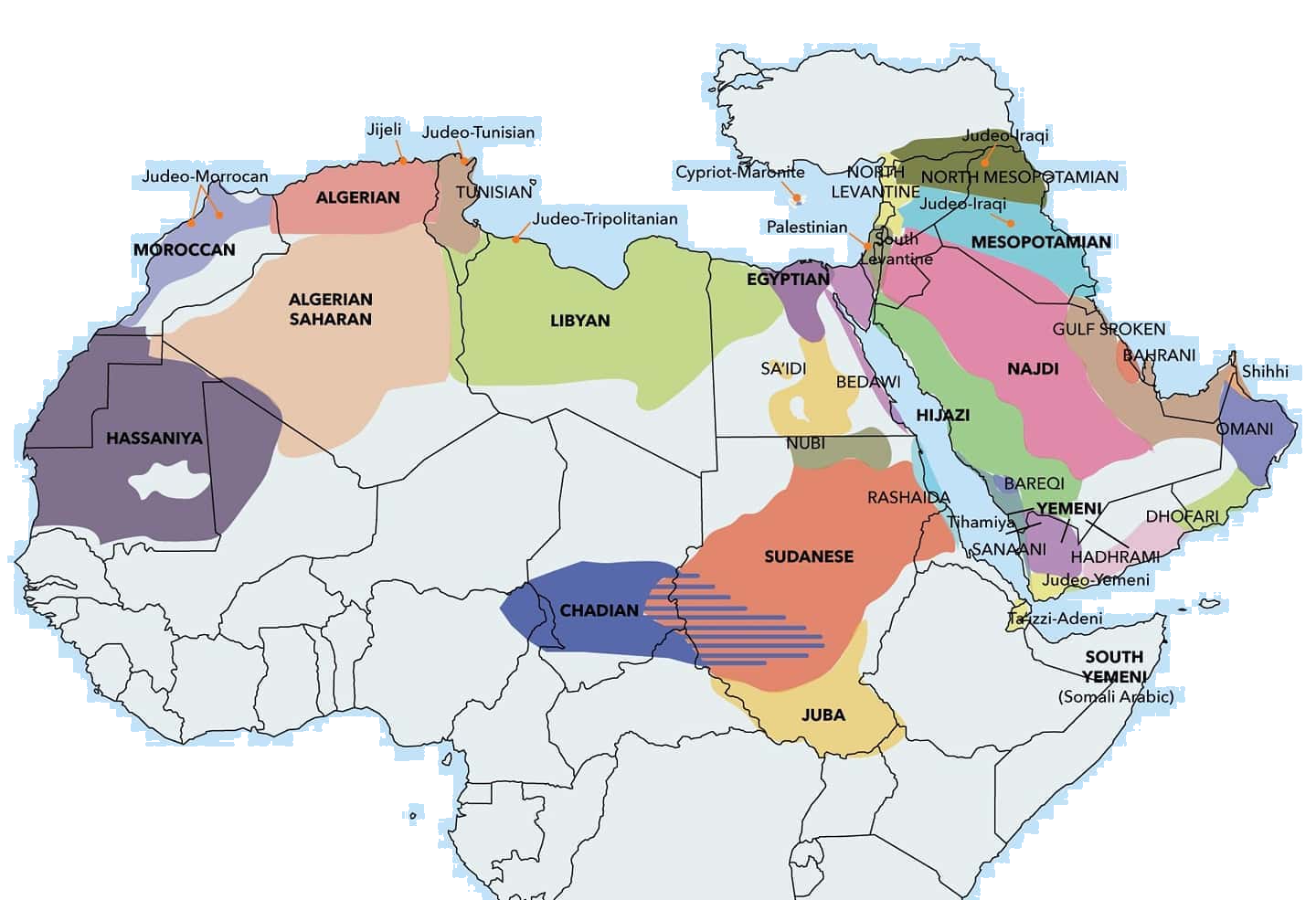
The map shown above, which aims at providing a general representation of the diversity of the major Arabic dialects in the Arabic world, could lead one to think that political borders play a role in dialectal variations, but that is not entirely true. A more accurate and relevant way to look at dialectal variations are a regional and historical approach, that considers social and geographical elements. Furthermore, it is common to find more than one dialect within most of all these Arabic countries, just as it is the case in Jordan.
I will start with a brief (and non exhaustive) history of Jordan and the evolution of what we call Jordanian Arabic that was influenced by different cultures and language backgrounds. Arabic was not always the dominant language in today’s Jordan, but I will only focus on it’s Arabic era, that progressively became dominant around the Umayyad period, replacing the former languages over centuries of transition. Arabic was already present in parts of the region before Islam, but it is considered that the major linguistic transformation came with the Muslim conquest in the 630s CE. At the time, Damascus (in today’s Syria) was an important center of Arabic culture and influenced the Jordanian dialect with older Levantine Arabic varieties. In addition to this, modern Jordanian Arabic was also very much influenced by bedouin dialects from the Arabian Peninsula and Syrian/Iraqi deserts.
During the Ottoman Empire that spanned over four centuries (late 15th until early 20th century), Turkish was the language of imperial administration while Arabic was the spoken language in Jordan. This is why there are some traces of Turkish in Jordanian Arabic but it is not a major influence. It is more importantly during the 20th century that Jordanian Arabic was subject to the widest changes and transformations due to the historical events of that period.
The creation of the modern Jordanian State (around 1946-1949) brought together populations with different dialect backgrounds from Palestine. After the Nakba in 1948 by the Israelis in Palestine, Jordan gained control of the West Bank in April 1949, and the country's official name became the Hashemite Kingdom of Jordan. This migration wave, followed in 1947 by an other major migration wave of Palestinians fleeing the Naqsa, significantly shaped the Jordanian Arabic dialect that is spoken today.
Let’s have a closer look at the several subgroups and language variations in Jordan, while I would like to stress that if you travel to Jordan, you will find a Jordanian dialect that is spoken and understood by the vast majority of Jordanians and they can all communicate and understand each other at a national level despite the regional variations that are spoken by the different communities.
- The Urban Jordanian Dialect (UJA) is the «dominant dialect, so to speak, alongside with MSA in Jordan as it is considered more prestigious than other dialects since it is spoken by the educated and the elite people.» (M. Al-Deaibes, 2016 ; p. 21) This dialect is «mainly spoken in the big cities (Amman, Zarqa, and Irbid) and by city dwellers who are originally Palestinians or Syrians, who migrated to Jordan in the past two centuries due to wars, expulsion, and political unrest» (ibid). Hence the urban Jordanian Dialect is very close to Syrian, Palestinian, and Lebanese Arabic.
- « Bedouin Jordanian Arabic, on the other hand, is spoken by the desert dwellers (nomadic tribes) in the northern, eastern and southern parts of Jordan » and « according to Sakarna (1999), there are five main Bedouin dialects in Jordan spoken by five different Bedouin tribes […] » in Jordan. (Mutasim Al-Deaibes, 2016 ; 23). The Bedouin influence is particularly important in Jordan and still today, their dialects can sound quite different from the speech of Amman or Northern Jordan, in terms of pronunciation as well as grammar and vocabulary.
- The Rural Jordanian Arabic «is mainly spoken by villagers (farmers) who live in the suburbs and the countryside of north Jordan like the districts of Al-Ramtha, Bani Kanana, Bani Ebeid, and Al-Koura and the city of Der’aa and its villages in Syria. This variety is also spoken by city dwellers who are originally from the suburbs but moved to the city.» (Mutasim Al-Deaibes, 2016 ; 23).
Now finally, let’s norrow our study down to the city of Amman, capital of Jordan. It is interesting to look at Amman, for it knew a very important growth in the late 1940’s as a result of being the destination of multiple migration waves from all over the region. Therefore, according to M. D. Hanania «the ‘native’ Ammani itself is also a misleading term because all of the town’s inhabitants (the Hashemites, Circassians, Chechens, Syrians, Palestinians, migrants from East Bank towns and villages, Armenians, and others) had migrated to Amman» (M. D. Hanania, 2014 ; p. 19) As a result, Ammani Arabic became a particularly mixed urban variety, while the most important influence comes from the major demographic changes following the Nakba and Naksa in 1948 and 1967 with massive waves of Palestinian refugees fleeing to Jordan. This is why today Palestinian and Jordanian Arabic (considering here the dominant speech) are very close and share many similarities.